
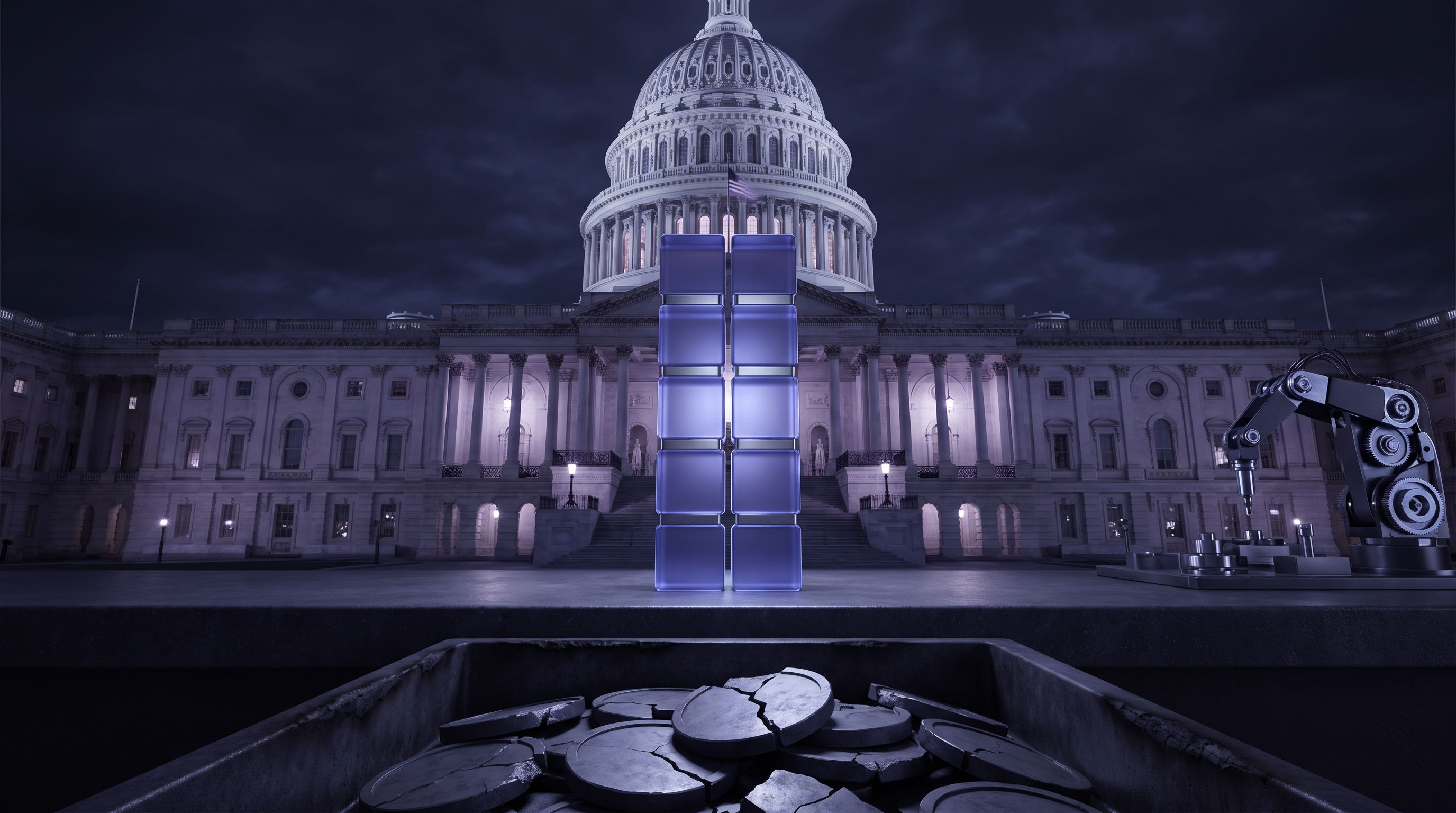
SBA Chief Loeffler Pushes Congress to Double the $5 Million Loan Cap as Defaults Hit a 12-Year High
A July 4 rule already lets one borrower stack $10 million across 7(a) and 504. The taxpayer guarantee behind each borrower has not moved, and early defaults are running at 2.5 times last year's rate.
What happened. SBA Administrator Kelly Loeffler said in a Forbes interview published July 27 that she "absolutely" supports doubling the statutory cap on 7(a) small-business loans from $5 million to $10 million, a limit that has not moved since 2010. "Our loan limits stopped going up in 2010. So 16 years ago was the last increase," she said.1
Half of it already happened. On July 4, SBA Policy Notice 5000-879058 took effect, decoupling the 7(a) and 504 programs so a single borrower can hold $5 million in each at the same time, $10 million of SBA-backed financing in total. American Banker called it the first increase in the cumulative cap since 2010.2 3 4
Congress holds the other half. Raising the 7(a) cap itself requires legislation. The Made in America Manufacturing Finance Act, which would lift the limit to $10 million for manufacturers producing entirely in the United States, passed the House unanimously in December 2025 and awaits a Senate vote. Loeffler expects it to pass "as part of defense funding."1 5 6
The backdrop the announcements skip. The push to write bigger loans lands on a program running its hottest credit stress in over a decade. The 7(a) trailing-twelve-month default rate reached 4.8% in March 2026, the highest since 2013, per Lumos Data's analysis of SBA loan-level records, and early defaults in the $500,000 to $1 million bucket ran 1.41% in 2026 against 0.56% in 2025, roughly 2.5 times higher in one year.7 18
What Alternative Business Lenders Need to Know
What exactly did Loeffler say, and what has already changed?
The interview is a policy signal with a legislative vehicle attached. Asked whether the $5 million 7(a) ceiling should double, Loeffler answered "I absolutely would," and framed the case around manufacturing costs: a factory buildout with robotics and automation "costs much more than $5 million."1 She is not waiting on Congress to move what she can move herself. In May the agency announced it would decouple its two flagship programs, and Forbes reported at the time that the change would push maximum combined SBA financing to $10 million, the highest in agency history.10 That rule, Policy Notice 5000-879058, dated May 18, took effect July 4.4 The volume context matters too: the agency approved more than 63,000 7(a) loans in fiscal 2025 but only 43,000-plus so far this fiscal year, a decline Loeffler attributes largely to government shutdowns, including a 43-day lapse she says cost "$2 billion to $2.5 billion" in lending opportunity.1
What does the July 4 rule actually do?
Before July 4, a borrower's 7(a) and 504 exposure shared one $5 million ceiling. Now they are decoupled: an outstanding 7(a) loan no longer reduces available 504 capacity, so a qualifying business can hold $5 million in each program at once. The asymmetry is deliberate. A 504 loan still counts against 7(a) capacity, so the sequencing that unlocks the full $10 million is 7(a) first, 504 second.3 9 The number that did not move is the one taxpayers stand behind: maximum SBA-guaranteed exposure to any one borrower and its affiliates stays at $3.75 million, or $4.75 million with a qualifying export loan.9 In other words, the agency doubled how much credit can be originated under its brand without expanding the federal backstop per borrower. The incremental risk on the larger stacks sits with the lenders and CDCs writing them. TD Bank's head of SBA lending, Tom Pretty, made the inflation case for going further: "What has inflation done since 2010. That $5 million cap's inflation adjustment is $7.5 million or $8 million."2
Where does Congress stand?
The statutory piece is the Made in America Manufacturing Finance Act, H.R.3174, sponsored by Rep. Roger Williams of Texas. It would raise the 7(a) limit to $10 million, but only for small manufacturers whose production facilities are entirely in the United States; any reliance on international production disqualifies the borrower from the higher ceiling. The House passed it unanimously on December 2, 2025, and it has sat with the Senate since.5 6 Loeffler publicly backed the bill at passage, saying manufacturers were "one step closer to unlocking the capital they need," and now expects it to ride into law attached to defense funding.11 1 A unanimous House vote plus an administrator lobbying for a defense-bill rider is about as strong a passage setup as small-business legislation gets. The open question is whether the manufacturers-only fence survives, or whether a broader cap raise gets negotiated in once the number is open.
What does the credit picture look like underneath?
Stressed, and in a specific shape. The underlying record is the SBA's own loan-by-loan 7(a) FOIA file, released quarterly on the agency's open-data portal, so every figure that follows is rerunnable by any credit team against the primary data.18 Lumos Data's July analysis of those loan-level records puts the 7(a) trailing-twelve-month default rate at 4.8% as of March 2026, the highest since 2013 and up from a trough of 1.6% in 2021.7 The characterization is not one vendor's: trade coverage was already calling the fiscal 2024 rate of 3.7% a 12-year high, and tracing it to the 2023 and 2024 guarantee-fee cuts and eased underwriting that the agency has since reversed.17 The vintage curves are worse than the headline: fiscal 2023 and 2024 cohorts are defaulting at roughly 3.4% in year one, more than double the 1.6% first-year rate of the fiscal 2016 vintage, and early defaults in the $500,000 to $1 million bucket jumped from 0.56% to 1.41% in a year. Sector dispersion is wide, with transportation and warehousing defaults at 7.6% across more than 15,000 active loans in the first half of fiscal 2026, and lender dispersion is wider still: among 36 institutions with $1 billion-plus 7(a) portfolios, 2025 default rates ranged from 0.5% to 12.3%.7 Early defaults are the number to watch because they indict underwriting rather than the economy: a loan that fails in its first year usually should not have been written, whatever the cycle is doing.
Why push bigger loans into a program running hotter?
Because the constituency for bigger loans is loud, and the constituency for tighter vintages is a spreadsheet. Lenders have lobbied for a higher individual cap since well before this administration; through June 2 the program had approved $19.4 billion of 7(a) loans this fiscal year against $4.6 billion of 504.2 Larger loans also carry a defensible credit argument: Lumos's own size-bucket data shows loans above $500,000 defaulting at lower conditional rates than loans under $350,000, so shifting mix upmarket does not mechanically add risk per dollar.7 But the same dataset shows the $500,000 to $1 million bucket producing the fastest-deteriorating early defaults of any size class, which is exactly the neighborhood the new stacked structures and a doubled statutory cap would populate. The honest read is that the agency is scaling loan sizes and tightening credit at the same time, and which force wins will show up in the fiscal 2026 and 2027 vintage curves, not in any announcement.
What does this mean for alternative lenders?
The competitive effect concentrates in the bankable middle. Construction firms financing sites and equipment simultaneously, manufacturers pairing real estate with working capital, and logistics operators buying trucks and warehouses are the profiles the decoupled structure was built for, and businesses that previously topped up an SBA facility with alternative capital can now complete the stack inside the guaranteed channel.8 That is real share loss at the margin for equipment finance and larger working-capital facilities aimed at SBA-eligible borrowers. The limit of the threat is speed, and it is structural, not cyclical. As Funder Intel put it, the businesses that use alternative financing "aren't typically the ones that qualify for $10 million in SBA-backed loans, they're the ones that need capital tomorrow, not in 45 days."8 SBA underwriting still runs weeks to months, its collateral and documentation demands have tightened this cycle, and a fenced, manufacturers-only statutory raise would leave most MCA, factoring and revenue-based borrowers exactly where they are today. The play is not to compete with a guaranteed 10-year note on price; it is to price the waiting room: bridge-to-SBA structures, speed at renewal, and the borrowers the program's tightened credit box now declines.
Our Opinion
The interesting number in this story is the one that did not change. By holding per-borrower guaranteed exposure at $3.75 million while doubling originable volume to $10 million, the SBA has effectively asked its lender network to take more true credit risk under the program's brand. That is a quiet structural shift: 7(a) has always sold itself to lenders as a guarantee wrapper, and the wrapper just got proportionally thinner at the top of the market. Lenders with 0.5% default books will price that correctly. The ones running 12.3% are the reason the words "guarantee" and "brand" should not be doing underwriting work, and the roughly 25-fold dispersion between those two numbers is the most honest description of the program's current health.
For alternative lenders, the strategic error would be reading this as a pure threat. A government program moving upmarket into $5 million to $10 million stacked deals, with 45-day-plus timelines and a tightening credit box, creates its own exhaust: declined borrowers with bankable financials, approved borrowers who need interim capital before funding, and renewal cliffs when covenants on bigger facilities bite. The program's own data says its fastest-growing problem is loans that fail in year one, which means its credit box will keep tightening even as its ceiling rises. Capital that shows up in days, priced honestly for the risk, is not competing with that machine. It is collecting what the machine cannot process.
1-Minute Video: Use ChatGPT to Predict Loan Defaults
Early defaults are an underwriting problem. Underwriting is a data problem.
With 7(a) defaults at their highest since 2013, the distance between a 0.5% book and a 12.3% book comes down to what the credit team knew about the business before funding.
This one-minute walkthrough pulls structured business data with Cobalt's Company Lookup API and feeds it to an AI model to flag likely defaults before they reach the portfolio.
or
Free Tools for Lending Teams
Headlines You Don’t Want to Miss
Bloomberg reported July 27 that SoftBank's $40 billion bridge loan, arranged in March to fund a $30 billion follow-on investment in OpenAI through Vision Fund 2 plus $10 billion of general corporate needs, has pulled in 21 new lenders taking roughly $7 billion in a broader syndication phase. First Abu Dhabi Bank, GIC and Standard Chartered each took close to $1 billion, joining lead arrangers including JPMorgan, Goldman Sachs, Mizuho, SMBC and MUFG on a facility that matures March 25, 2027, one of the largest bridge financings ever done in the Asia-Pacific.12 13 The operator read: the single largest bid for bank balance sheet right now is an equity bridge into AI, and every billion parked there is syndication capacity and risk appetite not chasing middle-market credit. When the largest names in global banking are queuing for tech-adjacent exposure, spread discipline in ordinary commercial lending tends to follow.
PitchBook's PC Monitor puts second-quarter US direct-lending volume at $33.59 billion, down about 55% from $74.67 billion in the first quarter and the lowest since Q2 2023, with deal count at 184, the fewest since Q3 2023.14 The other half of the divergence: North America closed-end direct-lending funds raised $16.25 billion in the same quarter, up from $1.3 billion in Q1 and the strongest fundraising in two years, as volatility, geopolitics and retail redemptions weighed on deployment.15 This is the sequel to the redemption story we led with on July 4 and the KKR exit review we covered on July 25: capital keeps arriving while lending falls, which means dry powder is stacking against a shrinking deal set. When deployment resumes, that overhang prices loans down. Alternative lenders funding against private credit facilities should expect their own lenders to get hungrier, and cheaper, into year-end.
US banking-infrastructure provider Mbanq said July 27 that a Swiss private bank, unnamed in the announcement, became the inaugural institutional investor in its $100 million loan participation note programme, with the dollar-denominated notes admitted to trading on the Dusseldorf Stock Exchange's Open Market. The capital funds expansion of Mbanq's lending operations and its earned wage access offerings for banks, credit unions and fintechs. CEO Vlad Lounegov called it "an important milestone" demonstrating "confidence in our long-term strategy."16 Two things worth noting from the funding-desk view: a listed note programme is a repeatable rail, not a one-off facility, which makes it a template other embedded-lending platforms can copy, and the use of proceeds puts fresh institutional money behind EWA just weeks after a federal earned-wage bill advanced out of House committee, a sector we flagged July 9. Watch whether the investor base broadens beyond the first name; programmes like this live or die on the second buyer.
Sources
1 Forbes | SBA Chief Loeffler: It's Time To Raise The $5 Million SBA Lending Cap
2 American Banker | SBA Raises Cumulative Loan Cap for First Time Since 2010
3 SBA.gov | SBA Doubles Cumulative 7(a) and 504 Loan Limit to $10 Million
4 SBA.gov | Policy Notice 5000-879058: Coordination of 7(a) and 504 for Maximum Loan Limits
5 Manufacturing Dive | House Lawmakers Pass Bill to Double SBA Loan Limits for Manufacturers
6 Congress.gov | H.R.3174, Made in America Manufacturing Finance Act
7 Lumos Data | SBA 7(a) Default Rates 2026: Small Business Credit Risk Data
8 Funder Intel | SBA Just Opened the Door to $10 Million Deals. Here's Who Benefits
9 Orrick InfoBytes | SBA Raises Cumulative Loan Limits for Certain Agency-Backed Financing Programs
10 Forbes | SBA To Double To $10 Million Maximum Loans For Some Small Businesses
11 SBA Press Release | Administrator Loeffler Applauds House Passage of Made in America Manufacturing Finance Act
12 Bloomberg | SoftBank's $40 Billion Loan for OpenAI Stake Gets 21 New Lenders
13 The Japan Times | SoftBank's $40 Billion Loan for OpenAI Stake Gets 21 New Lenders
14 PitchBook | Amid Market Shift, US Direct Lending Activity Nears Three-Year Low
15 Private Equity Wire | US Private Credit Fundraising Rebounds Despite Sharp Fall in Direct Lending Activity
16 Fintech Global | Mbanq Lands First Institutional Backing for $100M Note
17 TOD Tax | SBA Loan Defaults Are at a 12-Year High. Here's What Lenders Need to Do Now
18 SBA Open Data | 7(a) & 504 FOIA Loan-Level Dataset
